



DIY Golf Sim Enclosure vs Ready-Made Options (UK)
Published: 28.10.2026 / Last updated: 28.10.2026

You’ve seen enclosure kits priced at over £1,000, you’ve priced the materials at a fraction of that, and building one looks like an obvious win. Sometimes it is. But the people who’ve actually done it keep describing the same few problems, and none of them is the frame. We build golf rooms, not enclosures, so there’s no kit here we’d rather you bought, and that makes this an easier conversation to have.
Your own golf sim room – no reseller mark-up
Summerhouse24 builds every cabin in-house.You get the ceiling height, insulation and craftsmanship a proper golf sim room needs at a genuine factory price.
Free UK delivery included.
Rated 5 stars on Trustpilot by thousands of customers across Europe.



DIY golf sim enclosure: what building one actually involves
A DIY enclosure is made of a frame, the fittings that join it, an impact screen tensioned with bungee cords, fabric for the top and sides, and foam over the pipes and the gap around the screen. The frame is the easy part. Builders say so repeatedly, and the trouble tends to turn up in the details around it.
- Pick the screen first, then build the frame to fit it. Impact screens come in fixed sizes, so building the frame first and hunting for a screen afterwards is how you end up with gaps. A basic impact screen starts from around £140 in the UK.
- The gap between the frame and the screen is where most DIY builds go wrong. One builder spent hundreds of dollars and weeks of trial and error closing gaps with foam, blankets and tape, and wished they’d bought a kit instead. Another found that putting the frame too close to the screen caused serious ricochets, and fixed it by moving the frame back and holding the screen with bungee cords. That matches the 30–40cm of clearance behind a screen we recommend in our sizing guide.
- Foam protection is where the money goes. One builder who’s made two enclosures says the frame is easy and the padding is what gets expensive and looks poor if done badly. He also says conduit wrap and pool noodles aren’t safe, though other builders happily use noodles. If you’re hitting drivers into it, we wouldn’t rely on noodles.
- Frame material is a real trade-off. Timber is the simplest route, because it needs nothing more specialised than screws and brackets, and it’s what we’d use for full swings. A metal frame can work too, but it needs proper tube clamp fittings for the tees and corners. Those are sold for scaffold-style galvanised tube rather than electrical conduit, they run roughly £11–£21 each on UK listings, and a frame needs several, so the fittings can cost more than the tube. Some retailers argue against PVC entirely because it can crack and send fragments flying. Whichever you pick, add a baffle net inside the screen to soak up impact energy.
On cost, UK retailer Tekden’s own budget breakdown prices a DIY PVC frame or basic net at £100–£300, plus a basic screen from £140. That puts a DIY screen and frame at roughly £250–£450 before foam, fabric and fixings. The claim that you can build a whole enclosure for next to nothing usually leaves the screen out, and the screen is the most expensive part.

Best golf sim enclosure: ready-made options in the UK
There isn’t one best enclosure, only the best one for your room. These are SimSpace models, one of the more common ranges in the UK, with prices from UK retailers. They vary between shops and go out of stock, so check the current price.
- For a shallow room, the SimSpace SLIM is around £1,000. It’s designed for shallow rooms, with extended side netting and a three-layer platinum screen.
- For a small standard room, the Sim-1 is around £1,300. It measures 2.6m wide, 2.5m high and 1.5m deep.
- For a larger room, the Sim-5 runs roughly £1,300–£1,600 depending on the retailer. It’s a 3m cube with a deeper box for ball containment.
- For the widest screen, the Sim-6 is 4m wide, 3m high and 3m deep.
The catch is height. The larger SimSpace models are 3m tall, so a room with a 2.7m ceiling won’t take one. Check the enclosure’s height against your ceiling before you pick a size.
Screens come in tiers too. SimSpace’s Elite screen starts from about £300, and the three-layer Platinum from about £500, with a foam layer that helps cut the noise of impact. At the top end, Foresight’s dual-layer screen kit is £2,160. The screen is also where you can’t afford to economise, whichever route you take.
-
Fast deliverySKU G0349
Garden Golf Simulator Room-2 6x4m | 70 mm
£11,450.0027m270mm468x618 cmBlack Friday! Extra -£1,000 at checkout
-
SKU G0398
Garden Room "Golf Simulator 5" 28m² | 6 x 4 m | 70mm
£13,200.0028m270mm640x490 cmBlack Friday! Extra -£1,000 at checkout
-
SKU G0410
Golf sim cabin "Ibiza" 33m² | 9 x 4 m | 70mm
£13,725.0033m270mm920x410 cmBlack Friday! Extra -£1,000 at checkout
DIY or buy?
Buy a kit if you’re short on time or the room is tight. The gap and padding problems are exactly what a kit has already solved. Build your own if you’re handy, the space is an awkward shape, or you want a specific size no kit comes in. Either way, put the money into the screen first.
Sorting the room around the enclosure? See our golf sim rooms, our golf simulator room ideas for screen and projector placement, or our cost breakdown for what the rest of the setup costs.
Categories:
Guides
Tiny homes have gone from a niche idea to a regular fixture of UK property feeds, TV and Instagram. The appeal is easy to see: lower bills, less stuff, a smaller footprint and a building you can understand from end to end. The reality in the UK is more complicated. Planning law has no category…
Are you wondering what is the purpose of a sauna hat? The first time you see someone walk into a sauna wearing a felt hat, it can frankly look silly. Something you’d buy at a Christmas market and never wear again. Then you sit on the top bench for ten minutes without one, feel the…

Your own sauna and cold plunge at home make for a real treat any time of the year. While most garden buildings find less use in winter, saunas still earn their keep and it’s not hard to see why. When it’s cold and dark outside, the better that first wave of heat feels. In Finland…
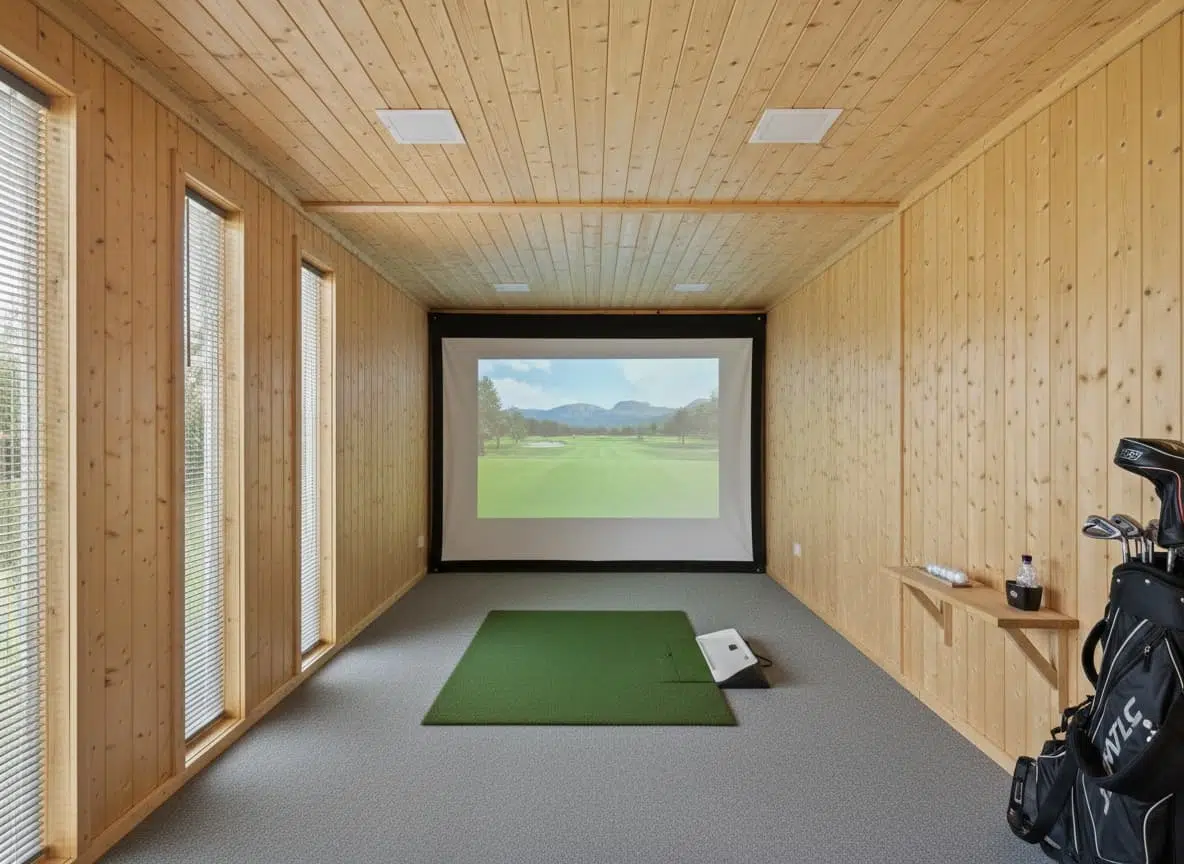
If you’re looking for a golf simulator dimensions guide, we’ve got you covered. Once you’ve measured the garage, or paced out the bottom of the garden, and you’ve got a number. The space measurements dictate which launch monitor you can put in the room. A space that suits a camera-based unit may be too shallow…
Want to discuss over phone. Let us call back to you
If you need any additional info regarding any product, please fill in the below form and we will get back to you, usually the same or next working day.
Have any questions regarding some product?
If you need any additional info regarding any product, please send us your questions.