




Garden Office Cost in the UK (Your 2026 Guide)
Published: 02.12.2024 / Last updated: 05.06.2026

Last updated: 14.02.2026
In recent years, garden offices have become increasingly popular. This is true for all of the United Kingdom, offering homeowners a perfect blend of work-life balance and functional home improvement. But how much does a garden office cost? After all, many of us have budgets to consider. This guide will break down everything you need to know about garden office pricing in the UK.
Table of contents
- How much does a garden office cost in the UK in 2026?
- Key factors that determine the cost of a garden office in the UK
- Additional garden office costs to consider
- How to keep the cost of your garden office down in 2026
- Do you get any tax relief when you work from a garden office?
- Financing options for a garden office
- Conclusion
- Frequently asked questions

How much does a garden office cost in the UK in 2026?
Most homeowners spend between £12,000 and £30,000 once groundwork, installation and electrics are included. The final cost depends heavily on insulation level, wall thickness, glazing quality and foundation type.
Here is a realistic overview of current garden office costs in the UK:
| Type of garden office | Typical price range |
| Budget prefab (basic insulation) | £5,000 – £12,000 |
| Standard insulated garden office | £10,000 – £25,000 |
| High-end bespoke build | £25,000 – £50,000+ |
| Average cost per square metre | £1,200 – £2,500 per m² |
A garden office that looks affordable at first glance can quickly become expensive once insulation upgrades and groundwork are added. It helps to see what’s actually included before you commit.
5-star Trustpilot rating · Factory direct · 20+ years of experience
-
Fast deliverySALESKU G0097
Large Garden Hobby Room Barbados 21m² | 6 × 4 m | 44mm
Original price was: £7,250.00.£6,250.00Current price is: £6,250.00.21m244mm553x393 cmBlack Friday! Extra -£500 at checkout
-
Fast deliverySALESKU G0303
Garden Office Ryan-I 14m² | 5 x 3 m | 44mm
Original price was: £5,900.00.£4,800.00Current price is: £4,800.00.15m244mm498x298 cm -
Fast deliverySKU G0249
Garden Office Room "Barcelona" 21m² | 6 x 4 m | 44 mm
£6,375.0021m244mm553x393 cmBlack Friday! Extra -£500 at checkout
Key factors that determine the cost of a garden office in the UK
Garden office cost in the UK isn’t determined by one single number. Two buildings can look similar online but differ by £10,000 or more once insulation, groundwork and installation are factored in.
While basic prefab models may start around £5,000, most fully insulated, year-round garden offices typically land between £12,000 and £30,000 once base, electrics and installation are included. Bespoke architectural builds can exceed £50,000.
Here’s what actually drives that difference.
Size matters
Size is one of the main factors when it comes to the prices of garden offices. The more material you use, the more expensive anything becomes. Smaller, lightly insulated garden offices may start from a few thousand pounds for the structure only. Let’s look at average prices for garden offices according to their size.
| Small garden offices (2m x 2m – 3m x 3m) | About £4,000 – £7,000 |
| Medium garden offices (4m x 4m – 5m x 5m) | £6,000 – £8,000 |
| Large garden offices (5m and over) | £8,000 – £15,000 |
** These size-based figures reflect structure-only pricing. Once groundwork, insulation upgrades and installation are included, total project costs are typically higher.
Construction materials
Timber: Timber comes in several quality grades and a garden office can be made from cheaper pine vs more expensive Nordic spruce for example. Nordic spruce, which is used by Summerhouse24, is a dense slow-grown timber that is far more superior to cheap pine.
High-quality materials: While the initial cost will seem higher for a garden office with quality components such as double-glazed windows and premium hardware, the longevity of the materials is significantly better.
Complexity of the design
Clean rectangular designs are cheaper to manufacture and assemble.
Costs increase when you introduce:
- Large sliding or bifold glazing systems
- Wraparound verandas
- Custom rooflines
- Full-height glass walls
- Internal partition walls
Bespoke designs are also often on the higher end of the price scale, because they require additional engineering, glazing support and installation time, all of which raise the total build cost.
Summerhouse24 lets you conveniently change any existing designs or create a new bespoke project at a very competitive price, thanks to in-house manufacturing.
Foundation and groundwork
Your garden office is only as good as the base it sits on. Cutting corners here is one of the fastest ways to create long-term problems.
Different foundation types suit different budgets, soil conditions and access constraints and the cost between them can vary significantly.
Here’s a realistic 2026 overview:
| Base type | Cost range | Best for | Things to consider |
| Concrete slab | £1,500 – £3,000+ | Permanent, heavy log structures | Most stable option but higher labour and material cost |
| Concrete strips | £1,200 – £2,500 | Larger structures with load-bearing walls | Requires excavation and skilled installation |
| Ground screws | £1,000 – £2,500 | Sloped or uneven ground | Faster install, minimal excavation |
| Paving slabs | £800 – £1,800 | Smaller to medium offices | Needs careful levelling and solid sub-base |
| Plastic grids | £600 – £1,500 | Budget-conscious builds | Not ideal for very heavy structures |
| Timber frame | £800 – £1,800 | Temporary or lighter buildings | Requires good drainage and airflow |
| Foundation kit | £500 – £1,000 | Designed specifically for compatible models | Often fastest and most cost-effective for prefabricated systems |
What else affects groundwork cost?
Even if the base itself is affordable, site conditions can increase spend:
- Sloping gardens requiring excavation
- Clay-heavy soil needing stabilisation
- Limited access requiring manual material transport
- Drainage improvements
- Removal of existing patios or sheds
Ground preparation alone can add £500 – £2,000 depending on complexity. A high-quality insulated garden office deserves a base that supports it properly. The foundation doesn’t just affect stability, it also impacts moisture control, longevity and long-term performance.
A garden office should feel solid, warm and built to last.
Quality timber, proper wall thickness and a compatible foundation system make all the difference.
Best base kit in UK · Factory direct – No middlemen · 20+ years of experience
-
Fast deliverySALESKU G0097
Large Garden Hobby Room Barbados 21m² | 6 × 4 m | 44mm
Original price was: £7,250.00.£6,250.00Current price is: £6,250.00.21m244mm553x393 cmBlack Friday! Extra -£500 at checkout
-
Fast deliverySALESKU G0303
Garden Office Ryan-I 14m² | 5 x 3 m | 44mm
Original price was: £5,900.00.£4,800.00Current price is: £4,800.00.15m244mm498x298 cm -
Fast deliverySKU G0249
Garden Office Room "Barcelona" 21m² | 6 x 4 m | 44 mm
£6,375.0021m244mm553x393 cmBlack Friday! Extra -£500 at checkout
Installation
DIY installation may reduce upfront labour costs but requires experience and time.
Professional installation for an insulated garden office typically costs between £1,200 – £3,000 depending on the size and complexity of your build. For very large structures, this may be higher.
Quick garden office cost driver summary table:
| Cost factor | How it affects garden office cost |
| Size | Larger footprint = higher timber and glazing cost |
| Wall thickness | Thicker logs increase durability and price |
| Insulation level | Higher insulation increases usability and cost |
| Glazing | Large sliding doors significantly increase price |
| Foundation | £500 – £3,000 depending on base type |
| Installation | £1,200 – £3,000 if professionally fitted |
Beyond the structure, base and installation, there are a few additional costs homeowners often overlook. Let’s look at those next.
Additional garden office costs to consider
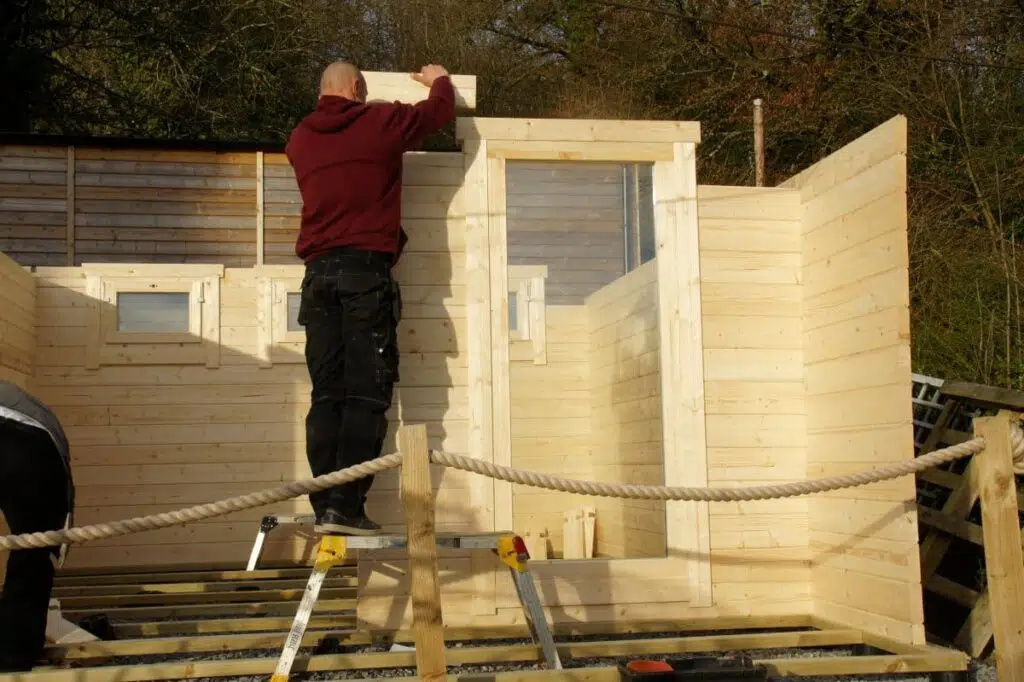
Even once you’ve chosen your garden office model, there are several additional costs that can influence the final budget.
Planning Permission and building regulations
Most garden offices under 30m² fall within permitted development rights, meaning planning permission is not usually required.
However, permission may be needed if:
- The building exceeds 2.5m in height within 2m of a boundary
- Your property is listed
- You live in a Conservation Area or similar designated location
- The building is intended for residential use
If planning permission is required, application fees in England are typically around £258 (Scotland, Wales and Northern Ireland vary slightly), though if you need additional architectural drawings you should add £300–£1,000 depending on complexity.
Even when planning isn’t required, building regulations may apply if the office is highly insulated, includes electrics, or is intended for year-round use. Always check with your local authority before starting work.
Site preparation
Ground preparation is one of the most underestimated costs.
Even if your base is already budgeted, site conditions can add expense. Common groundwork costs include:
- Levelling uneven gardens: £300 – £1,500
- Removing old patios, sheds or decking: £300 – £2,000
- Drainage improvements: £200 – £1,000
- Soil stabilisation in clay-heavy areas: varies significantly by region
In total, site preparation typically adds between £500 and £3,000 depending on access, slope and soil condition.
Gardens with narrow access or terraced layouts may require manual material transport, which increases labour costs.
Electrical installation and internet
If your garden office is being used daily, electrics are essential.
Typical electrical installation costs in 2026:
- Basic power and lighting: £800 – £1,500
- Consumer unit upgrade (if required): £300 – £800
- Data cabling or ethernet connection: £150 – £500
Wi-Fi extenders can work for garden offices within 20–30 metres of the main house, but for stable video calls and large file transfers, a hardwired ethernet connection is often more reliable.
All electrical work must be carried out by a qualified electrician to comply with UK building regulations.
Heating and cooling
If you plan to use your garden office year-round, temperature control becomes important.
Typical heating options include:
- Wall-mounted electric panel heaters: £150 – £400
- Infrared heaters: £200 – £600
- Air conditioning units with heating function: £1,000 – £2,500 installed
Proper insulation is far more important than heating type. A well-insulated garden office retains warmth efficiently and reduces ongoing running costs. There are also many eco-friendly ways to heat your garden office.
Cooling is often overlooked in the UK, but south-facing offices with large glazing (like contemporary garden rooms with floor-to-ceiling windows and sliding doors) can overheat in summer without shading or ventilation.
How to keep the cost of your garden office down in 2026
Buying a garden office isn’t just about finding the cheapest price. It’s about getting the right specification for your needs without paying for features you won’t use.
Here’s how to control costs without cutting corners:
1. Be realistic about size
Oversizing is one of the most common budget mistakes. A 3m x 3m insulated office is enough for most single-desk setups. Jumping to 5m+ can add thousands in timber, glazing and base costs.
2. Choose insulation wisely
If you’re using the office year-round, insulation is non-negotiable. But if it’s occasional use, you may not need the highest-spec thermal upgrade. Match the spec to the use.
3. Compare like-for-like quotes
Some lower headline prices exclude:
- Base preparation
- Installation
- Electrical connection
- VAT
A £6,000 “starting from” model can easily become £12,000 once everything is included. Always ask what’s included in writing.
4. Consider in-house manufacturers
Manufacturers who design and produce their own buildings (rather than reselling third-party kits) can often offer stronger value for the same quality, because fewer middle margins are added. It is also worth considering that a quality build has longer-term implications: a well-specified garden office can add measurable value to your property, which a cheaper, poorly finished structure is unlikely to do.
Summerhouse24 manufactures directly from our own factory, using quality-controlled Nordic spruce throughout. There are no middlemen and no imported markups — just a well-built timber office at a fair price.
5. Buy off-season
Winter and early spring often bring promotions or shorter lead times. Demand peaks in late spring and summer, which can influence both price and availability.
Do you get any tax relief when you work from a garden office?
Tax treatment depends entirely on how the garden office is used.
If you are self-employed or running a limited company, you may be able to claim:
- A portion of utility costs
- Office equipment and furniture
- Potential capital allowances depending on structure classification
If you are employed, tax relief is more limited and typically only applies if:
- Your employer requires you to work from home, and
- They do not provide a suitable alternative workspace
Tax rules change, and interpretation depends on structure type (temporary vs permanent). Always seek professional tax advice before assuming eligibility.
Financing options for a garden office
Garden offices are increasingly treated as long-term home improvements rather than temporary outbuildings.
Common funding methods include:
- Personal savings
- Home improvement loans
- Remortgaging
- Staged payment plans (where available)
Spreading the cost of your garden office can make sense if the office replaces commuting costs or external office rental but interest costs should always be factored into the true total investment.
Conclusion
The cost of a garden office in the UK isn’t a single fixed number. It’s a combination of structure, insulation level, glazing, foundation, installation and site conditions.
In 2026, most homeowners investing in a fully insulated, year-round garden office will realistically spend somewhere between £12,000 and £30,000 once groundwork and electrics are included. Smaller prefab models can start lower, while bespoke architectural builds can exceed £50,000.
The biggest pricing differences usually come down to:
- Size and footprint
- Wall thickness and insulation
- Glazing systems
- Foundation choice
- Installation method
A lower upfront price doesn’t automatically mean better value. A properly insulated, structurally sound garden office can last decades and remain usable year-round. That longevity is often what makes the investment worthwhile.
Before making a decision, clarify how you plan to use the space, whether you need full-year insulation, and what level of finish matches your long-term plans. When you understand the full cost picture, you’re far more likely to choose the right build from the start.
Planning for a garden office?
If you’re ready to stop working from the kitchen table and invest in a space that actually supports how you work best, the next step is to look at real models with transparent specifications.
Summerhouse24 designs and manufactures insulated timber garden offices using slow-grown Nordic spruce, with options for bespoke sizing and year-round upgrades.
Best base kit in UK · Factory direct – No middlemen · 20+ years of experience
-
Fast deliverySALESKU G0097
Large Garden Hobby Room Barbados 21m² | 6 × 4 m | 44mm
Original price was: £7,250.00.£6,250.00Current price is: £6,250.00.21m244mm553x393 cmBlack Friday! Extra -£500 at checkout
-
Fast deliverySALESKU G0303
Garden Office Ryan-I 14m² | 5 x 3 m | 44mm
Original price was: £5,900.00.£4,800.00Current price is: £4,800.00.15m244mm498x298 cm -
Fast deliverySKU G0249
Garden Office Room "Barcelona" 21m² | 6 x 4 m | 44 mm
£6,375.0021m244mm553x393 cmBlack Friday! Extra -£500 at checkout
Frequently asked questions
In 2026, the average garden office cost per square metre in the UK typically ranges between £1,200 and £2,500 per m².
The final price per square metre depends on wall thickness, insulation level, glazing systems, foundation type and whether installation is included. Highly insulated, year-round garden rooms with premium glazing will sit toward the higher end of that range.
A fully insulated garden office suitable for year-round use usually costs between £12,000 and £30,000 once groundwork, base and electrics are included.
Smaller insulated prefab models may start lower, while larger log-style or bespoke designs with upgraded glazing and finishes can exceed this range.
The main hidden costs of a garden office are usually related to groundwork and utilities rather than the structure itself.
These can include:
– Site levelling or excavation
– Drainage improvements
– Electrical connection from the main house
– Internet cabling or signal boosters
– Base upgrades
– Removal of existing sheds or patios
Ground preparation alone can add £500 to £2,000, depending on site conditions. Clarifying these costs early helps avoid surprises once installation begins.
According to experts, the average value a proper contemporary garden room can add to a house is 5% to 15%. How do you make sure that you’re closer to the higher end of the scale? By choosing a high-quality garden office that complements your outdoor space and the main house. An unattractive garden office in disrepair is more likely to lower the value of your property instead of increasing it.
It depends. As long as your garden office is on the smaller side, it should fall into your permitted development rights – this means you can put up small structures such as sheds and garden rooms on your own land without planning permission (some exceptions include listed buildings and natural conservation areas).
The inside area of the garden office should not exceed 30 m2 and if located within 2 meters of the property boundary, it can’t be higher than 2.5 metres. Planning permission rules for garden offices differ by council, so the best thing is to check with your local planning authority.
For many people, a garden office is absolutely worth it. The additional space and flexibility can significantly improve the quality of life. This can be even more true when people additionally use the space for hobbies or get a model with a veranda, that allows them to enjoy the outdoor space in a relaxing way in the evenings.
First and foremost, a garden office should be considered as a long-term investment. You’ll be saving on renting an office space or commuting, not to mention the time it takes to travel to an office. You also may be improving the quality of your everyday life, cutting out stress and leading to better health outcomes. The value of your property will also increase, if you install a good quality garden office, that future buyers or even renters will see as a desirable feature.
Tiny homes have gone from a niche idea to a regular fixture of UK property feeds, TV and Instagram. The appeal is easy to see: lower bills, less stuff, a smaller footprint and a building you can understand from end to end. The reality in the UK is more complicated. Planning law has no category…
Are you wondering what is the purpose of a sauna hat? The first time you see someone walk into a sauna wearing a felt hat, it can frankly look silly. Something you’d buy at a Christmas market and never wear again. Then you sit on the top bench for ten minutes without one, feel the…

Your own sauna and cold plunge at home make for a real treat any time of the year. While most garden buildings find less use in winter, saunas still earn their keep and it’s not hard to see why. When it’s cold and dark outside, the better that first wave of heat feels. In Finland…
You’ve seen enclosure kits priced at over £1,000, you’ve priced the materials at a fraction of that, and building one looks like an obvious win. Sometimes it is. But the people who’ve actually done it keep describing the same few problems, and none of them is the frame. We build golf rooms, not enclosures, so…
Want to discuss over phone. Let us call back to you
If you need any additional info regarding any product, please fill in the below form and we will get back to you, usually the same or next working day.
Have any questions regarding some product?
If you need any additional info regarding any product, please send us your questions.