



Log Cabin Office Ideas For Every UK Garden
Published: 15.09.2026 / Last updated: 14.09.2026
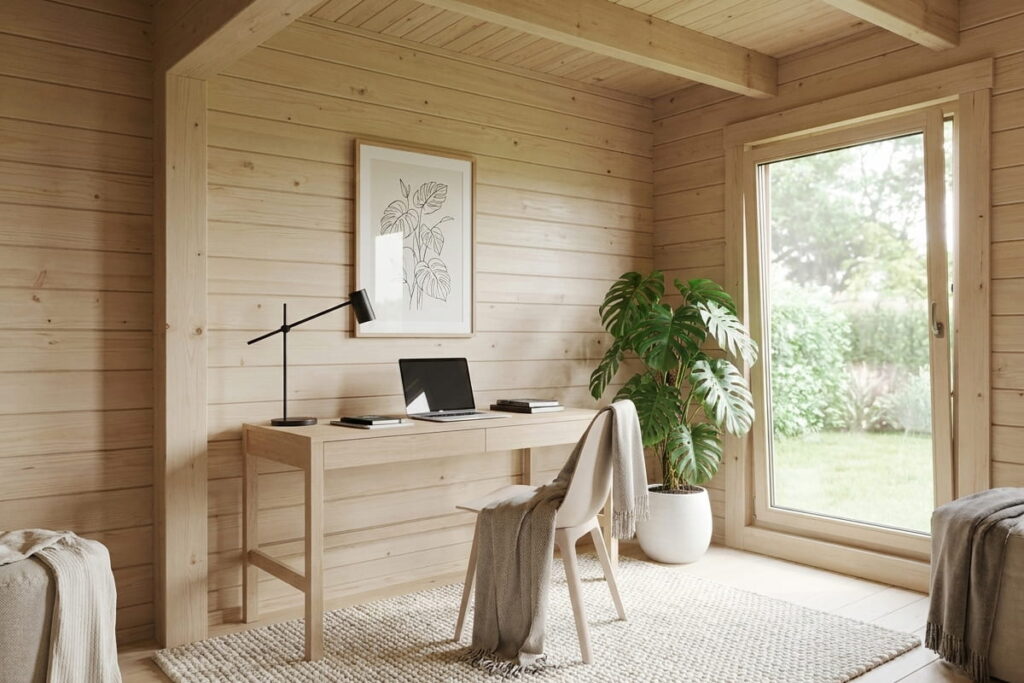
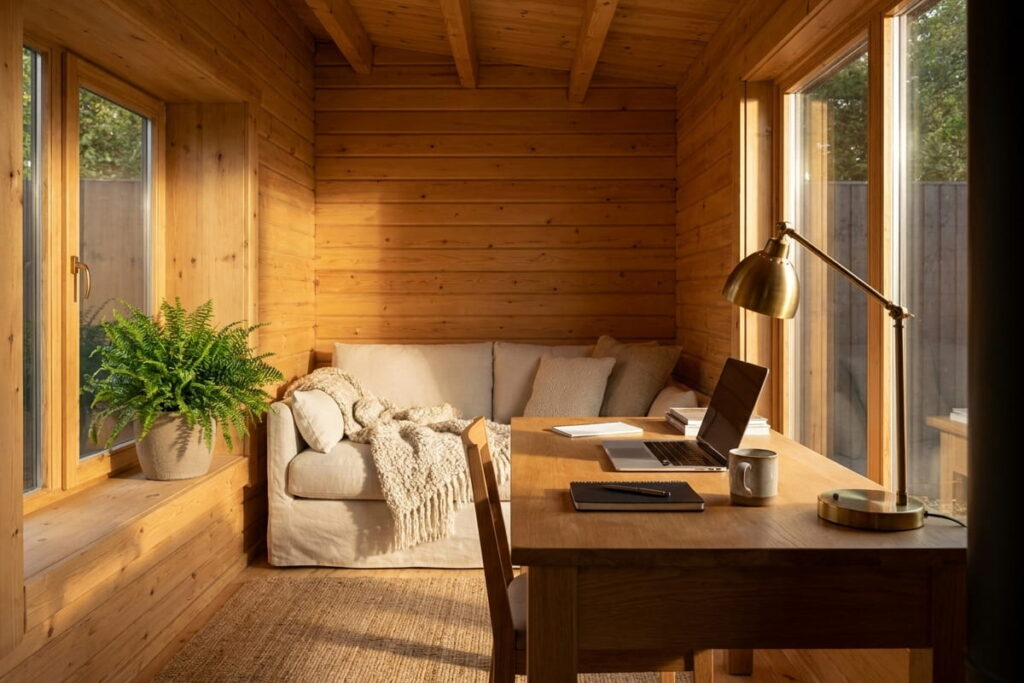
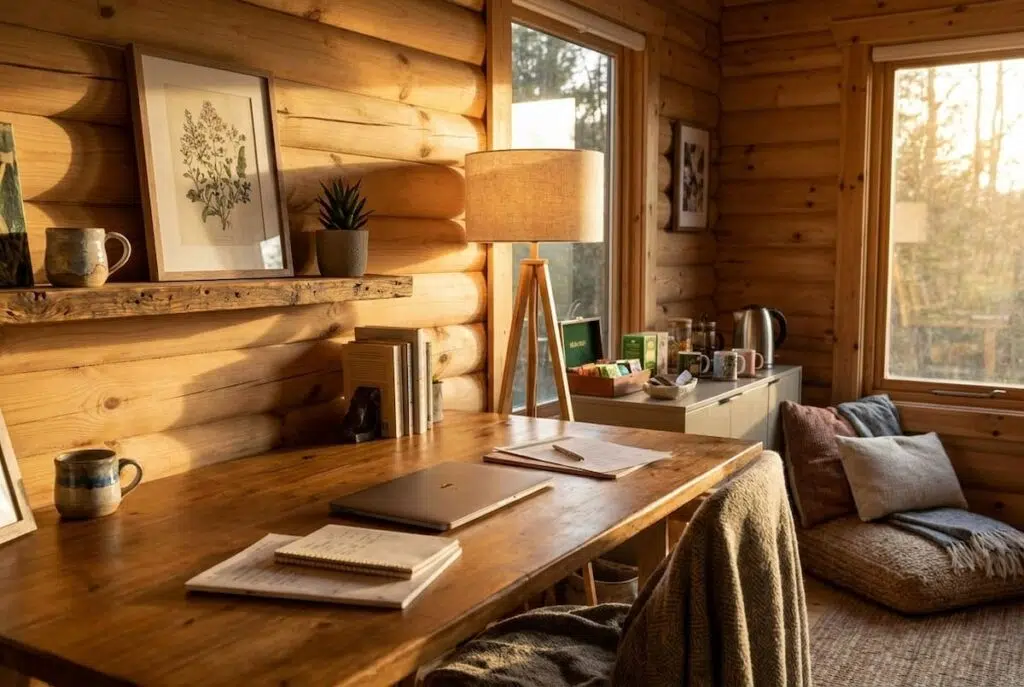
Looking for some log cabin office ideas for your UK garden?
Working from a log cabin at the bottom of the garden looks picturesque in every home office feature spread. But, does reality matches the curated scenes on the photograph? We know that with the right choices the dream holds up in practice too.
A well-built log cabin brings genuine warmth and character to a workspace, along with a level of solid, thick-walled construction that a standard shed or summerhouse simply doesn’t offer. The part most articles skip is which choices actually make the difference between a beautiful photo and a room you want to sit in for eight hours a day.
Home offices are one of the most consistent reasons people get in touch with us, and for good reason. A log cabin office gives you a proper timber structure to build a working routine around. Below is what we’d tell a customer planning one, followed by the practical ideas that make the difference once it’s built.


Why a log cabin works so well as a home office
The advantage of a log cabin office starts with the thick timber walls and sturdy construction. A basic garden shed or lightweight summerhouse is built from thin cladding boards over a frame, whereas a log cabin’s walls are solid interlocking timber, typically starting from around 44mm. At Summerhouse24, every log cabin has a minimum wall thickness of 44mm, with a 70mm upgrade available on many models and an 88mm glue-laminated (glulam) option on our largest cabins.
That extra mass holds a stable internal temperature far better than a standard shed. Though it’s worth being clear that thickness alone isn’t a substitute for proper insulation. This is especially true if you plan to use the office through the winter. Our guide to wall thickness and U-value comparison go into the numbers if you want to compare options properly before ordering.
A better work environment improves productivity and increases general wellbeing
There’s also a less measurable advantage: most people simply find it easier to concentrate and stay comfortable in a timber room than in a plastic or thin-panel building. It’s a small thing, but over 8 hours, day-in, day-out, it adds up.
Timber also takes almost any finish, so the same office cabin can end up looking contemporary, rustic or considerably more polished. It all depends on how you treat and furnish it. In the long term, a beautiful and comfortable working space improves general wellbeing and overall happiness.
Investing in a log cabin office: Does it add value to my property?
It’s worth being upfront about investing in a log cabin office that is at a genuinely comfortable standard. Proper wall thickness, insulation, good glazing, a finish that lasts — is a real investment, and the total climbs with how much comfort you’re after. That’s easier to justify once you look at what it gives back. Garden offices have been shown to add real value to a property — research reported by Property Reporter puts the average uplift at 8.4%, around £22,739, though the honest range depends heavily on build quality, size and location.
And because a well-built log cabin is a genuinely multipurpose, durable structure, the investment isn’t tied to it staying an office forever. It converts easily into a guest room, gym or studio later on if your circumstances change.
Because so much of that value comes down to build quality rather than square footage, it’s worth being particular about who you buy from.
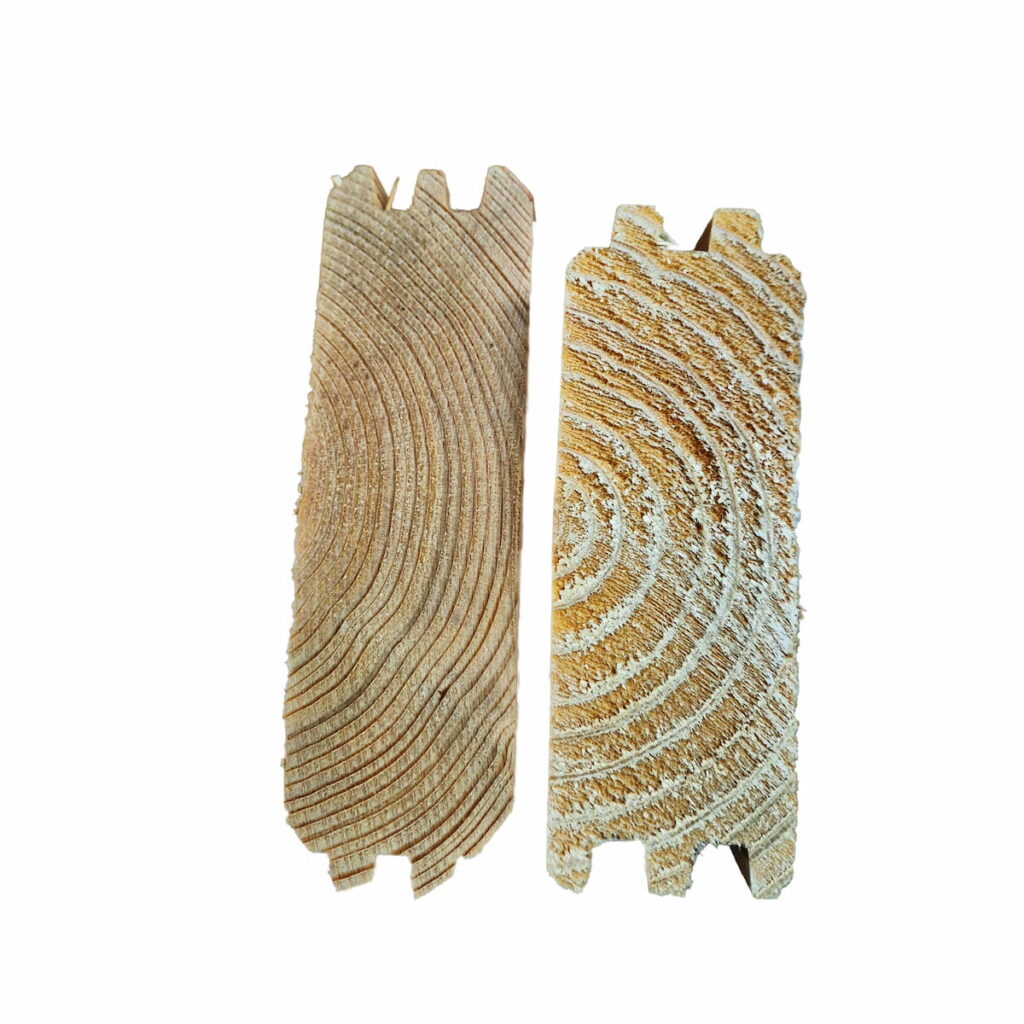
Two spruce cross sections side-by-side.
On the left: Summerhouse24 timber, with narrow, uniform growth rings – a sign of slow growth, high density, and long-term stability.
On the right: a competitor’s timber, with wider growth rings, showing faster growth and lower density.
The difference in growth ring density is visible in a photo like that in a way a spec sheet can’t quite convey — denser, slow-grown timber holds heat better and lasts longer. Which is the whole point of treating this as an investment in the first place.
We build our own office cabins at our factory rather than buying in from third parties, with 20+ years of manufacturing experience and 10,500+ structures shipped across the UK, which is why we can speak specifically about timber quality here rather than in generalities.


With the shell settled, the ideas below are what actually shape whether the office gets used properly.
1. Choose the right log thickness for year-round use
Decide how much of the year you’ll actually work from the cabin before you pick a wall thickness. If it’s genuinely a full-time, all-seasons office, 44mm with added insulation is the sensible minimum. Stepping up to 70mm or 88mm glulam gives you a meaningfully lower U-value before insulation. However, 44mm with wall, ceiling and floor insulation is an excellent choice that keeps
2. Size the space around how you actually work
A 3x3m cabin suits one person with a desk, a chair and a couple of shelves. If you have clients visiting or a second workstation, you’re better off with 3x4m or larger. Walk through an actual working day before you settle on a floor plan. Think about where you’ll take video calls, where paperwork piles up and whether you need room to pace during a phone call.
It’s also worth pausing here if you’re weighing up a larger, multi-room cabin rather than a single-room office. A bigger footprint with an internal partition gives you the flexibility to keep the office as its own room and still have a second space for something else entirely.
This could be a home gym, a small yoga studio, or a room set up for relaxing and hosting. It costs more upfront, but it’s a genuinely different proposition to a single-room office, so it’s worth deciding early rather than retrofitting a partition later.
3. Position your desk to use natural light
Face your desk side-on to the main window rather than directly facing it or with your back to it. Facing a window all day causes glare on screens and makes video calls look like silhouettes. Sitting with your back to it does the opposite and washes out your face on camera. Side-on light is flattering, reduces eye strain, and still lets you glance up and outside without needing to move.
You can also put up some curtains or blinds. With north-facing windows, fox example, a simple linen or cotton curtain may be enough to reduce the intensity of the sunlight. If you have south-facing windows and aren’t able to or don’t want to position your desk anywhere but at the windows, consider installing blackout blinds or curtains.
4. Get the windows working for quiet and airflow, not just light
Double glazing matters even more in an garden office than in a summerhouse you use occasionally. Every Summerhouse24 cabin comes double glazed as standard. This does two jobs at once: it cuts down noticeably on outside noise bleeding in and sounds from calls reaching the neighbours or family members in the garden.
It also keeps the cabin considerably warmer than single glazing would. This matters just as much to your heating bill over a working year as wall thickness does. For airflow, our windows are tilt-and-turn, so you can crack them open for ventilation without swinging a full casement into a tight desk layout. You can also open them fully when you want the room properly aired out.
5. Plan electrics and broadband from the start
Decide on your power and connectivity route before the cabin goes up, not after. A proper mains supply is notifiable electrical work and needs a qualified electrician. This is what gives you sockets, heating and lighting, rather than extension leads across the lawn.
For broadband, a simple Ethernet run alongside the power cable is usually more reliable than relying on Wi-Fi through two sets of timber and brick walls.
6. Heat the person, not just the room
Don’t rely on one heater to warm the whole cabin from a cold start. A modest background heat source keeps the worst of the chill off. Consider something like a small log burner or a low-wattage panel heater running on a thermostat.
The most economical setup pairs that with spot heating right where you need it: a small heater under the desk, or a heated mat for cold feet. To keep your hands warm, look for a keyboard hand warmer or a similar product.
7. Choose warm, practical lighting
Layer your lighting rather than relying on one central fitting. A single ceiling light leaves you working under flat, tiring light and casts shadows over your desk in the evening.
A home office does better with at least one ambient source plus a proper desk lamp for task lighting. Ideally, on a warmer colour temperature, so the room doesn’t feel clinical once the sun’s gone down.
8. Add smart storage to keep the space clear
Build storage into the layout rather than adding it afterwards. Wall-mounted shelving, a cabinet under the window, or a slim run of drawers beside the desk are great choices. They keep the desk and floor clean of any items that don’t have a place. In a compact cabin, clutter shows up fast and makes the whole space feel tighter than it is.
9. Invest in proper ergonomic furniture – and actually get up from it
Don’t furnish a home office with whatever chair was spare in the house. You’re likely to spend more consecutive hours in this chair than in any other seat you own. A proper adjustable office chair and a desk at the right height are worth it.
The other half of this is remembering to leave the chair: build in a couple of short standing or stretching breaks through the day, since long unbroken stretches of sitting aren’t great for you regardless of how good the chair is. A yoga mat rolled up in the corner is enough to make this easy to actually do.
10. Let the natural timber do the talking
Leave a good amount of the internal log wall visible rather than boarding or papering over it. The exposed timber is a large part of why a log cabin office feels different from a plasterboard box. It’s a good idea to keep furniture and decor to tones that sit well against the wood – whites, grays and blues.
If you paint the interior, you have more creative freedom. Have a look at the photos below for inspiration from real Summerhouse24 customers.


11. Create a clear boundary between home and work
Treat the walk to the cabin as part of your working routine, not just a commute across the lawn. A cabin that’s twenty metres from the house still needs a genuine start and end to the working day. Closing the door, changing what you’re doing, not wandering back and forth between “home” and “office” all day. This is arguably the biggest advantage a garden log cabin has over converting a spare room: the separation is physical, so it’s easier to make it mental too.
If the cabin doubles as anything else — a games room, a gym, a quiet spot to sit in the evening — that boundary needs a bit more help, because the room can’t rely on being “the office” the moment you walk in. Here’s a few ways you could make that switch happen:
- Give the desk setup an “off” state. Draping a scarf or a piece of fabric over an external monitor when you’re done for the day does more than you’d expect. A dark screen is a visual magnet for attention, and covering it removes that pull entirely, so the desk stops reading as “unfinished work” the moment you look at it.
- Put the laptop out of sight, not just closed. A tray or shallow drawer you slide the laptop into at the end of the day recreates the same effect as clearing your desk at an office.
- Let hobby objects come and go. If you use the cabin for a hobby too — a games console, a hobby project, an instrument — keep it in a small cupboard or cubby with a door or a cover, so it can sit in view while you’re using it and disappear again once you’re not, rather than competing for attention with your desk all day.
- Change the lighting when you switch modes. Turning off the desk lamp and task lighting and switching to a softer lamp or a different light entirely is a quick, physical signal that the room has changed function, even though nothing else has moved.
Make it a space that makes you want to work


Work takes up a huge share of your life, so there’s no real reason the room it happens in should be purely functional. The ideas above get the cabin working properly; this is about making it somewhere you’re actually glad to walk into, which tends to matter more for how the office gets used long-term than another spec upgrade does.
Bring in something that has nothing to do with productivity — but still feels like it belongs at your desk. A small object tied to a hobby, a favourite film or book character, or a gift from someone close to you. This could be a figurine on a shelf, a plant you’re fond of, a print.
The best version of this isn’t random clutter, though; it works best when it’s genuinely tied to how you want to feel while you’re working, so it becomes part of the mood of the room rather than just decoration. Swapping in small seasonal pieces through the year, or after a good call, is an easy way to keep this feeling current rather than static.
Build in a proper spot to stop. A small sofa, a daybed, or even a floor cushion in the corner gives you somewhere to lie down for five minutes between calls, rather than staying pinned to the desk chair all day.
Set up a small drinks corner. A kettle and a decent stash of tea or coffee nearby means you’re not walking back to the house every time you want a break. Some people go a step further with a proper coffee setup — syrups, cinnamon, the works — as a small, deliberate treat during the day.
Add a way to be a bit silly. Music you actually like, or even a compact karaoke setup for the days you need a five-minute reset, does more for your mood mid-afternoon than another motivational print on the wall. If noise carries to neighbours or the rest of the house, it’s worth factoring some extra sound insulation into the build if this is genuinely part of the plan.
None of this needs deciding before the cabin goes up. Most people add these details gradually over the first few months of actually using the space, once they know what they reach for on a hard day and what just sits there unused.
Does a log cabin office need planning permission?
Most log cabin offices fall under permitted development rights and don’t need formal planning permission, provided the structure stays within standard size, height and usage limits and isn’t used as separate living accommodation. Rules vary by property and local authority, particularly on listed buildings, conservation areas or larger plots, so it’s worth checking your specific situation before you order. Our planning permission guide for log cabins covers the detail.
Getting a quality log cabin office without overspending
The easiest way to compare build quality in person, rather than guessing from photos, is to see the wall thickness and finish for yourself. We have a display site in Devon where you can look at a range of log cabins before deciding.
Let Summerhouse24 help you design your log cabin office
We build every cabin from our own factory rather than through a reseller, which means we can talk you through wall thickness, insulation and layout for your specific plot rather than pointing you at a fixed spec sheet. Browse our full range of garden log cabins or get in touch and we’ll help you work out what fits your space and how you plan to use it.
Frequently asked questions
Most smaller models fall under permitted development rights. This is of course if they meet standard size and usage limits, but always check your local authority’s rules for your specific property, as there may be exceptions. Even if you do need planning permission, there’s no need to worry about it. The application process is straightforward and the vast majority of applications are successful on the first try. Just make sure to follow the rules and requirements set out by your local council and the process should go relatively smoothly.
44mm is a practical choice (with added insulation). 70mm logs or 88mm glulam logs give you a lower U-value before insulation. Upgrading to a higher wall thickness is a good idea if you’re after a more substantial building.
Generally yes, as summerhouses are intended for seasonal use. Thanks to thicker solid timber walls and insulation, log cabins are better suited for genuine year-round comfort.
Yes, absolutely. Running a mains supply out to a garden building is notifiable electrical work and should be carried out or signed off by a qualified electrician.
Categories:
Guides
Tiny homes have gone from a niche idea to a regular fixture of UK property feeds, TV and Instagram. The appeal is easy to see: lower bills, less stuff, a smaller footprint and a building you can understand from end to end. The reality in the UK is more complicated. Planning law has no category…
Are you wondering what is the purpose of a sauna hat? The first time you see someone walk into a sauna wearing a felt hat, it can frankly look silly. Something you’d buy at a Christmas market and never wear again. Then you sit on the top bench for ten minutes without one, feel the…

Your own sauna and cold plunge at home make for a real treat any time of the year. While most garden buildings find less use in winter, saunas still earn their keep and it’s not hard to see why. When it’s cold and dark outside, the better that first wave of heat feels. In Finland…
You’ve seen enclosure kits priced at over £1,000, you’ve priced the materials at a fraction of that, and building one looks like an obvious win. Sometimes it is. But the people who’ve actually done it keep describing the same few problems, and none of them is the frame. We build golf rooms, not enclosures, so…
Want to discuss over phone. Let us call back to you
If you need any additional info regarding any product, please fill in the below form and we will get back to you, usually the same or next working day.
Have any questions regarding some product?
If you need any additional info regarding any product, please send us your questions.